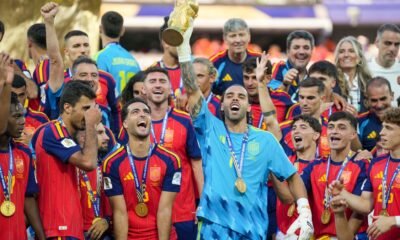
As the World Cup hurtles toward its Sunday conclusion, it is already a resounding success, both financially for its backers and culturally for the way it has brought together people from very different backgrounds to celebrate the beautiful game.
In games played in the three host countries of the United States, Mexico, and Canada, there were poignant, heartwarming scenes that could have been set to the soundtrack of “We Are the World.”
Haitians and Scots partying together before and after their countries squared off at Gillette Stadium, the Tartan Army winning over Americans with their unbridled joie de vivre.
A South Korea supporter sitting alone in a sea of Mexican fans who embraced and danced with him.
Brazilian supporters consoling heartbroken Japanese fans after Brazil knocked Japan out of the tournament.
It is tempting to be cynical about FIFA, soccer’s world governing body, widely viewed as the most corrupt sporting organization in the world, but it is impossible to deny the real human passion, and compassion, the games inspire.
Watching this World Cup, I couldn’t help but think of a great lost opportunity for greater unity.
In Ireland.
Nearly 30 years after the Troubles ended, reconciliation between Catholic republicans and Protestant loyalists in Northern Ireland, and between people in the Republic of Ireland and Northern Ireland, remains more an aspiration than reality.
I covered the conflict in Northern Ireland for many years and was based in Ireland full time in 1997 and 1998, when the peace process culminated with the Good Friday Agreement, which effectively ended the Troubles.
Those were heady days, and there were some then who suggested it was a perfect time to combine the two soccer federations — the Football Association of Ireland (FAI) in the Republic of Ireland and the Irish Football Association (IFA) in Northern Ireland.
That would prove to be easier said than done.
It is ironic not only that the football associations are known by their initials —just like the IRA and the UVF, paramilitary forces that sprang up in competing communities in the North — but that getting those football associations to make peace has proved harder than getting the paramilitaries to stop killing each other.
Before the partition of Ireland in 1920, there was an all-island soccer team. But it was not a unifying force. In fact, it mirrored the divisions in Irish society that would eventually lead to partition and then the Troubles, which the Irish, in their penchant for understatement, called their uncivil war.
Soccer became popular in the north of Ireland in the latter part of the 19th century, especially among the working classes of Belfast, where the original IFA, the island’s soccer governing body, was located from its inception in 1880.
Even as soccer became more popular in the south, where the games of hurling and Gaelic football had long prevailed, southern players complained that they rarely got a shot at making the national team.
The bias toward northern players, almost all of whom were Protestant and loyal to the British Crown, was blatant.
Almost all of the international games were held in Belfast, rather than Dublin, the island’s capital, and it was rare that a player from the south was selected for the national team.
In his book “The Irish Soccer Split,” Cormac Moore noted that just a few years after Northern Ireland exploded in 1968, there were concerted efforts to get the two football associations to join forces, with the idea of presenting a united front on an island that was bitterly divided.
Moore wrote that one of the most enthusiastic supporters of the idea was George Best, a Belfast Protestant and Manchester United legend who was arguably the most talented soccer player ever produced by the island of Ireland.
At the height of the Troubles, in 1973, a team of all stars from both the Republic and Northern Ireland took on Brazil, the greatest soccer nation in the world, in an exhibition match. The all-Ireland squad prevailed 4-3.
Moore described how a series of conferences in the 1970s ensued, aimed at bringing the two associations together. Alas, the violence and political infighting in the wider society made that impossible.
When I lived in Ireland, I had a chat at the Horseshoe Bar in the Shelbourne Hotel in Dublin with Eamon Dunphy, a former Republic of Ireland player and one of the nation’s preeminent soccer pundits.
Dunphy believed that had the associations managed to merge in the 1970s, the resulting team, led by Best and other Irish players like Liam Brady and Johnny Giles, could have been one of the best teams in Europe.
More important, he said, it would have given the working classes in the North who were doing all the fighting and dying something to coalesce around, a common ground where there was none.
“It was a massive lost opportunity,” Dunphy said.
After the Good Friday Agreement, Chris Patten, the last British governor of Hong Kong, was appointed to create a new police force that would be more representative of the population and accepted by Irish nationalists and British loyalists.
It was a steep order. During an interview, I asked Patten why the British and Irish governments didn’t insist on the merger of the two soccer federations as part of the peace process.
“It won’t happen,” Patten said flatly. He said creating a police force that was acceptable to both nationalists and loyalists would be easier than creating an all-island soccer team.
In particular, he said, loyalists would see ending the Northern Ireland team as yet another erasure of their identity.
Most sports have all-Ireland teams for international competition. Ireland’s boxers have punched above their weight in international competitions.
The best example of exploiting all-island talent is Ireland’s rugby team, which is consistently ranked as one of the top squads in the world.
Ireland’s success in rugby is a point of pride on both sides of the border, but rugby in Ireland is a mostly middle-class sport.
In working-class sections of Belfast, where the bulk of those involved in paramilitary activity hailed from, soccer was just another thing for the island to be divided over.
At the Felons Club, a social club in West Belfast, Catholic nationalists supported Celtic, the Glasgow-based soccer team in the Scottish Premiership. In another section of West Belfast, Protestant loyalists at a club on the Shankill Road supported Rangers, Celtic’s bitter rivals.
Martin O’Neill, who has the unique perspective of having been the captain of a Northern Ireland team and later manager of a Republic of Ireland squad, doubts that joining the two teams now would produce an overnight European powerhouse, as the two teams are similarly built and talented but frequently fail to qualify for the World Cup and European championships.
But he told The Irish News that had the two sides joined forces back in the 1970s, as George Best advocated, or the 1980s, when both teams were very good and possessed different but complimentary strengths, they would have produced teams that could have progressed deep into the European and World Cup tournaments.
And it would have produced a team that young people all over the island would aspire to play for and, at the very least, cheer for.
Either way, it was a lost opportunity, the unifying power of soccer left untapped on an island that could use a good stiff drink of harmony.
Kevin Cullen is a Globe columnist. He can be reached at kevin.cullen@globe.com.

Source link