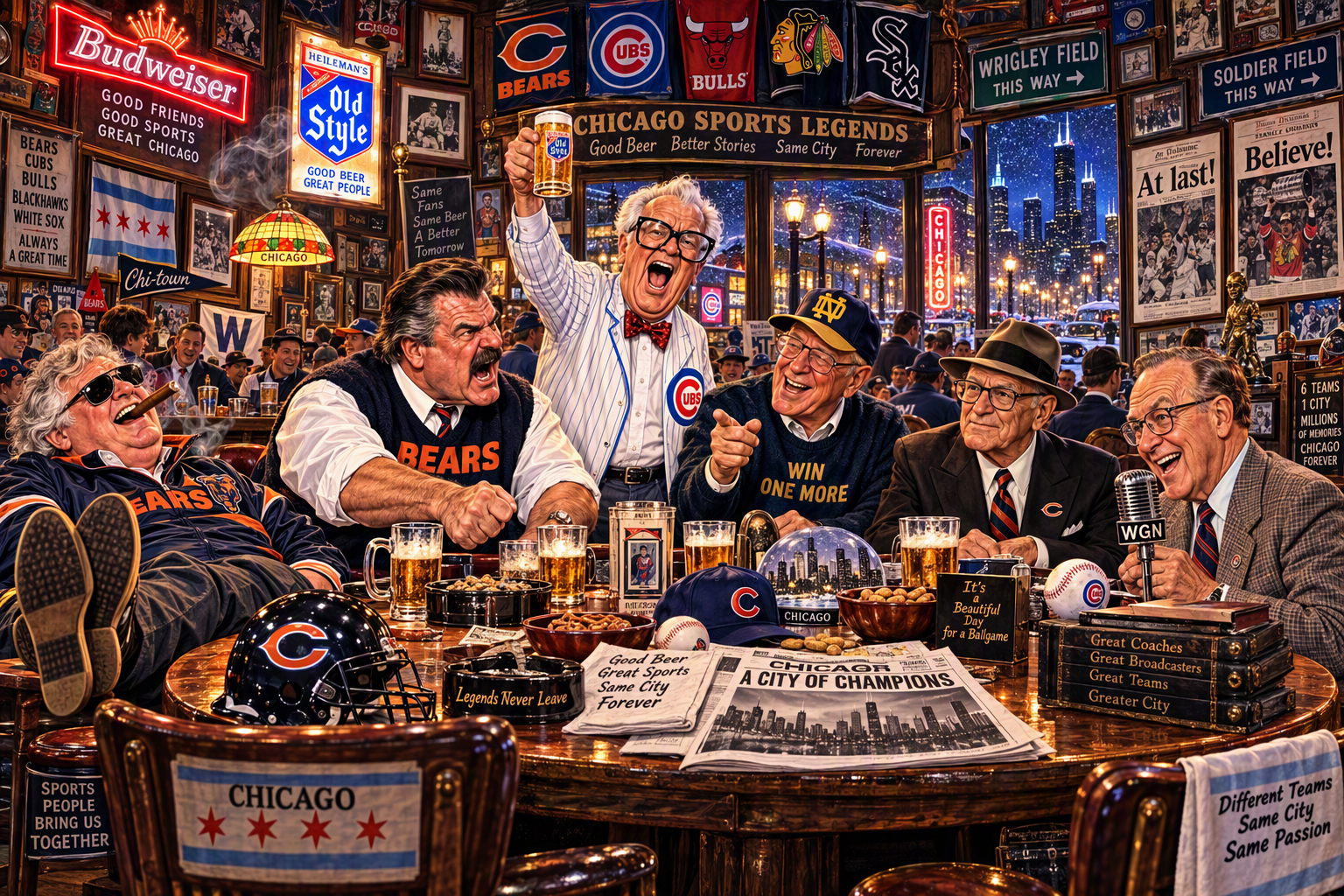
The snow falls outside the tavern windows as neon beer signs cast their glow across weathered wood walls covered with decades of Chicago sports history. At the center of the room sits a massive oak table cluttered with half-empty beer mugs, scorecards, newspapers, and stories waiting to be told.
Around that table are six men who helped shape the identity of Chicago sports.
A fiery football coach leans back with a cigar, convinced his defense could still shut down any offense ever assembled. Across from him, a mustached coach pounds the table, arguing that toughness wins championships and always will. Nearby, a beloved baseball broadcaster raises a beer high above the crowd, commanding everyone’s attention with the same larger-than-life personality that once echoed through television sets across the Midwest. A legendary college football coach listens carefully before jumping into the debate, while an aging football pioneer quietly observes the conversation. Beside them, a veteran broadcaster grips a vintage microphone, ready with another story from a lifetime spent covering Chicago sports.
Of course, this gathering never actually happened. Yet for anyone who has followed sports in Chicago, it is easy to imagine.
The city has produced some of the most memorable coaches, broadcasters, executives, and personalities in American sports history. More importantly, Chicago’s greatest sports figures were never simply employees of teams. They became cultural icons. They represented the blue-collar toughness, loyalty, resilience, and passion that have long defined the city itself.
Looking at a scene like this raises an interesting question. What made these personalities so unforgettable, and why do they continue to resonate with fans decades after many of them left the sidelines and broadcast booths?
The answer begins with authenticity.
Unlike modern sports, which often feel polished by public relations departments and social media managers, many of Chicago’s legendary sports figures built their reputations by being unapologetically themselves. They did not focus groups their personalities. They did not carefully script every public appearance. They said what they thought. Sometimes that got them into trouble. More often, it earned them the respect of fans who appreciated honesty.
Chicago has always demanded authenticity. Fans can quickly recognize when someone is pretending. The city’s sports culture was built on hard work, straightforward communication, and accountability. That is why so many larger-than-life personalities found a home there. The city embraced people willing to stand by their convictions, whether they were standing in a dugout, pacing a sideline, or sitting behind a microphone.
The significance of broadcasters in Chicago sports history cannot be overstated. Before social media, before streaming platforms, and before fans carried endless information in their pockets, broadcasters served as the connection between teams and their communities. They became trusted companions who accompanied families through countless summers, winters, victories, and heartbreaks.
For many Chicago fans, the voice coming through the television or radio speaker became as familiar as a family member.
Broadcasters transformed ordinary games into memorable experiences. They gave context to moments that otherwise may have faded into history. Their calls became part of family traditions. Entire generations can still recall where they were when they heard certain iconic calls, just as vividly as they remember the games themselves.
Coaches played a different but equally important role. Chicago has never fallen in love with coaches who simply won games. Chicago falls in love with coaches who embody the city’s identity.
The legendary coaches who captured the imagination of local fans typically shared a common trait. They projected strength and confidence, even in difficult moments. They expected accountability from players and themselves. They viewed obstacles as challenges rather than excuses. Whether facing a championship game or a rebuilding season, they displayed the kind of demeanor fans hoped they would bring to their own lives.
That mindset helped transform sports leaders into folk heroes.
The debates those coaches inspired continue decades later. Ask a room full of Chicago sports fans to identify the greatest team in city history and expect a heated argument. Some will point to dominant football teams. Others will choose championship baseball clubs or historic basketball dynasties. Every generation has its favorites.
Those discussions are part of what makes sports special.
Statistics tell only a portion of the story. Championships matter, but memories matter too. Fans remember where they sat when a championship was won. They remember the relatives they watched games with. They remember gathering around televisions, listening to radios, or celebrating at neighborhood bars.
Sports create emotional bookmarks throughout our lives.
That truth is reflected in every detail of the imagined Chicago tavern. The framed newspaper front pages hanging on the walls represent moments that stopped the city in its tracks. The old pennants and faded photographs symbolize generations of hope, disappointment, perseverance, and triumph. Even the glowing Budweiser and Old Style signs feel like reminders of a particular era in Chicago sports culture, when neighborhood taverns served as unofficial clubhouses for fans.
Long before online message boards and social media platforms existed, sports debates unfolded across bar tops throughout the city.
Friends argued over lineups.
Strangers became friends discussing coaching decisions.
Championship dreams were built one conversation at a time.
Those neighborhood gathering places played a significant role in Chicago’s sports culture. They provided a sense of community that extended well beyond the game itself. Sports became the common language that connected people from different backgrounds and professions.
In many ways, that sense of connection represents the true value of sports.
Championship banners eventually gather dust.
Records are eventually broken.
Even the greatest players are eventually replaced.
What remains are the stories.
The stories become family traditions passed from one generation to the next. Grandparents tell grandchildren about legendary teams and unforgettable personalities. Parents share memories of iconic games. Sports become part of a family’s collective history.
That dynamic is especially powerful in Chicago because the city’s sports history spans so many memorable eras. Every generation has experienced defining moments and unforgettable personalities. As a result, conversations about Chicago sports often become conversations about life itself.
The imagined tavern gathering serves as a reminder that sports are ultimately about people.
They are about the broadcasters who gave voice to unforgettable moments.
They are about the coaches who demanded excellence.
They are about the executives who built organizations.
They are about the fans who remained loyal through good seasons and bad ones.
Most importantly, they are about the memories created when those elements come together.
As the fictional evening draws to a close, the old tavern remains alive with conversation. One more story is told. One more argument breaks out. One more beer is raised in celebration of a city whose sports history is unlike any other.
Outside, snow continues to fall across Chicago.
Inside, the legends live forever.
And for sports fans, that’s exactly how it should be.
TheSportsBlitz.com is dedicated to the stories, personalities, moments, and memories that make sports more than a game. Whether it’s a championship season, a legendary coach, an iconic broadcaster, or an unforgettable fan experience, the stories behind sports are what bring us together.