A year ago today, the Boston Red Sox had just completed a weekend sweep of the New York Yankees and were boarding a plane to Seattle for a 10-day West Coast trip when they made a franchise-altering trade that shocked the baseball world.
Rafael Devers, their homegrown World Series champion, the $313.5 million third baseman-turned-designated hitter, got off the team plane that Sunday night when he received word he’d been traded to the San Francisco Giants.
In a weird twist, the Red Sox played the Giants later that week, adding more absurdity to an already unbelievable situation.
One year later, the Red Sox and Giants are both sub-.500 teams sitting at or near the bottom of their respective divisions.
What were the ramifications of the trade? How did it impact each club?
The Red Sox never replaced Devers’ bat and have one of the league’s worst offenses
There are a lot of variables at play here, from the team’s raw offensive numbers to the Red Sox failing to add to the offense this winter, but we’ll start with this: Boston’s offense has struggled mightily all season — before and after firing Alex Cora and six coaches, including most of the hitting staff, on April 25.
Before the firings, the Red Sox averaged 4.1 runs per game while posting a .233 average and .667 OPS in 27 games. In 42 games since, the Sox are averaging 3.95 runs while batting .255 with a .720 OPS.
Devers, meanwhile, isn’t having his best year at the plate, with career lows in average (.235) and OPS (.706). He heated up in May with a .949 OPS, but has cooled off again in June. Nevertheless, his bat in this lineup would surely make them better.
In trading Devers last June, the Red Sox planned to use some of the more than $250 million saved toward re-signing Alex Bregman.
They wrongly assumed they’d be able to bring back Bregman with relative ease, given how much he enjoyed his time with the club, but ran into a roadblock when Bregman was unwilling to budge on a no-trade clause. Bregman instead signed a five-year, $175 million deal with the Chicago Cubs.
The Red Sox had already added one bat in Willson Contreras via a trade with the St. Louis Cardinals in December. But in not bringing back Bregman (who’s also struggled this year with a career-low .686 OPS), they effectively lost another piece of the lineup.
Would Devers be enjoying a better season in Boston this year if he and the Red Sox had found a way to get past their differences? If Bregman re-signed with Boston, would he also have a better year at the plate? Would Marcelo Mayer and Roman Anthony be better off with Bregman around? It’s all impossible to predict how any of this would have affected the Red Sox’s offense, which is funny because the club relies heavily on its predictive models.
Their math said to move on from Devers and to only go so far on Bregman. And yet they’re still worse off.
Part of trading Devers was to make room on the roster for Anthony, then the No. 1 prospect in baseball. Devers had been DHing with Bregman at third, a major bone of contention that was somewhat smoothed out as the season progressed until the communication issues blew up again with the request for Devers to move to first following Triston Casas’ knee injury in May.
The Red Sox likely predicted Anthony would have emerged by now as a key bat for the top of the order, a reason why they only added Contreras this winter.
Instead, Anthony has missed significant time due to two injuries since debuting one week before the Devers deal last year. He missed the final 22 games of the regular season, as well as the three wild-card games with an oblique strain and has been out since May 7 with a sprained right ring finger that’s made swinging a bat without pain difficult.
In 101 career games, Anthony is batting .273 with an .804 OPS, but in 30 games before this season’s injury, he hit .229 with a .675 OPS. — McCaffrey
Devers the Dude?
When Giants president of baseball operations Buster Posey introduced Devers in a press conference on the suite level at Oracle Park a year ago, he described the left-handed hitting slugger with a term that players consider among the ultimate compliments.
“Inevitably, some baseball speak comes up,” Posey said. “We’ll say to each other, ‘Is this guy a dude?’ It’s not something you can quantify. It’s somebody that has the ultimate feel when the game’s on the line. He’s a type of player who makes his teammates around him better.
“Rafael Devers is a dude.”

Buster Posey and Rafael Devers shake hands at Devers’ introductory news conference on June 17, 2025. (Jeff Chiu / Associated Press)
One year later, at least when you consider where the Giants reside in the standings, the trade’s impact has been a dud.
The Giants were 41-31 when they wrote Devers’ name in their lineup for the first time on June 17 last year. Then they lost 10 of their next 14 games and went 40-50 the rest of the season while missing the playoffs. Fold in their 29-43 record this season and the Giants are 69-93 since making the trade. That’s simply stunning, and one heck of a head scratcher.
How much of it is Devers’ fault? Not all of it, that’s for sure. Last year, he was the player the Giants thought they acquired, posting a 130 OPS+ that was right in line with his career production in nine years with the Red Sox. Devers adjusted well enough to a difficult new home hitting environment, too, hitting 20 home runs in 2025 as a Giant — 11 in 175 at-bats at Oracle Park — to finish with 35 on the season. Devers also drew a career-high 112 walks, which almost doubled his previous best. And he agreed to take a crash course as a first baseman, something that was a no-go in Boston. It was rough initially, but Devers showed defensive improvement from series to series.
The Giants cratered anyway.
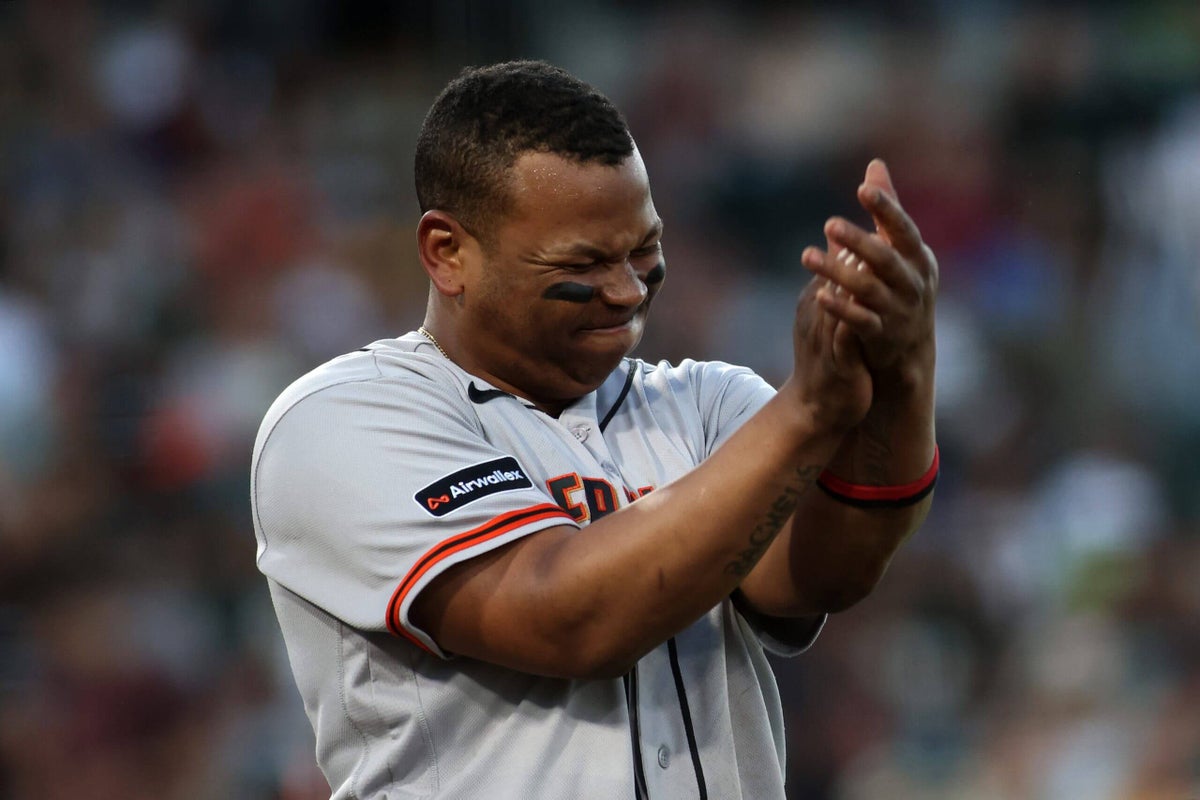
This season, it’s a little clearer to point to Devers as part of the problem. He has just a 100 OPS+ and is worth minus-0.9 Wins Above Average. His walk rate plummeted from 15.4 percent to 7.5 percent, which has been noxious for a team that is last in the major leagues in the category. His glacial start to the season was especially inconvenient because it came amid a lineup-wide slump that knocked the Giants to the fringes of contention before Memorial Day.
It was encouraging when Devers picked it up in May (.306/.356/.593) because the Giants tend to go how he goes. He’s got an .893 OPS in their wins and a .551 OPS in their losses. But thus far in June, he’s been back to his whiffing ways. — Baggarly
The prospects and players gained, then lost
The four players added in the Devers trade — three of whom were then traded away — have added another layer of disgrace to the deal.
The Red Sox acquired left-hander Kyle Harrison, right-hander Jordan Hicks, minor league outfielder James Tibbs III and minor-league right-hander Jose Bello in the Devers deal.
Last summer, in an effort to bolster an injury-riddled rotation in the final minutes before the trade deadline, the Red Sox sent Tibbs, alongside minor-league outfielder Zach Ehrhard, to the Los Angeles Dodgers in exchange for starter Dustin May.
May struggled mightily in Boston with a 5.40 ERA, his season ending with right elbow neuritis. He signed with the St. Louis Cardinals this offseason and has been a mainstay in the Cardinals’ rotation with a 4.21 ERA in 13 starts, but a 3.21 ERA since the start of May.
Meanwhile, Tibbs, a Giants first-rounder in 2024, has been one of the top prospects in the Dodgers’ system, hitting .307 with a 1.034 OPS in 65 Triple-A games before Sunday’s action. He was barely in Boston’s system for a month before they traded him away for a pitcher who didn’t offer much help.
Then there’s Harrison.
The Red Sox stashed Harrison in Triple A much of the summer before calling him up in September. He pitched in three games, including two starts, but the Red Sox never gave him much runway in the majors, calling up prospects Payton Tolle and Connelly Early before him.
Just before this season began, the Red Sox traded Harrison, pitcher Shane Drohan and infielder David Hamilton to Milwaukee in exchange for infielder Caleb Durbin and utilitymen Andruw Monasterio and Anthony Seigler.
Harrison has turned in an All-Star season for the Brewers with an 8-1 record and a 2.47 ERA in 13 starts. Durbin has been the Red Sox’s starting third baseman, attempting to fill an impossible hole at third in the absence of Devers and Bregman. Like much of Boston’s lineup, Durbin had a rough start to the year, hitting .163 with a .479 OPS through 48 games before a recent turnaround at the plate.

A teammate doused Kyle Harrison after he struck out 12 over 5 2/3 innings in an 8-3 win over the Giants on June 2. (Patrick McDermott / Getty Images)
Hicks struggled after landing in Boston, posting an 8.20 ERA in 21 relief appearances. His season ended with right shoulder tendonitis before he was traded this offseason to the Chicago White Sox, along with depth starter David Sandlin for minor-league starter Gage Ziehl, who’s pitched better of late but started the year on a rough note.
Bello is the only player remaining from the original Devers deal. The 21-year-old has a 3.04 ERA in eight games, five starts, in Single A.
Not only did the Red Sox trade away Devers and not replace his bat in a meaningful way, but they also didn’t properly assess or unlock the potential of two players they acquired. — McCaffrey
The Giants lost flexibility
A mediocre Devers hasn’t been the Giants’ only issue this season, or even the biggest one. Their mostly unimproved bullpen has been every bit the liability many predicted, and their rotation ERA is a lot closer to the Rockies’ than the Dodgers’. The Giants would probably have a losing record even if Devers owned a 130 OPS+.
If there’s extra consternation about Devers’ struggles, maybe that’s because the Giants are in the earliest stages of the massive contract they took off the Red Sox’s books. Devers is owed more than $220 million over the next 7 1/2 seasons, and the Giants won’t be finished paying the last of his deferrals until 2043, by which time McMurdo Station could be a summer vacation destination. In all likelihood, Devers won’t be a $30 million player in 2032 or ’33.
The Giants did the deal because of the impact that Devers could make on the front end. So when you aren’t getting that kind of impact now, what does that mean for the future? Especially when Devers and 21-year-old top prospect Bryce Eldridge are positionally limited to designated hitter or first base? The Giants gave up a lot of financial and positional flexibility when they took on the Devers contract. If he’s not pulling his weight, then he’ll be a major inconvenience to future roster building in more ways than one. — Baggarly
Craig Breslow on the hot seat
A year after the biggest trade of Breslow’s career, he remains on the hot seat. While CEO Sam Kennedy recently said Breslow’s job security “is not on the table,” the Red Sox have pulled an about-face too often to count.
The Red Sox have fired each of their three previous baseball operations leaders within four years of taking the job, and Breslow is in the midst of a wholly disappointing third season.
The massive Devers trade had a ripple-down effect across the organization from payroll to acquisitions to player development, and the franchise is in the midst of one of its worst stretches in recent memory.
Whether Breslow can repair this team remains the biggest question for the Red Sox heading into this summer’s trade deadline, but the ramifications of the deal and subsequent inability to improve the club may eventually cost Breslow his job. — McCaffrey
You need to give up something to get something … but maybe not that much?
It couldn’t have felt very good for Posey and GM Zack Minasian to watch the June 2 game in Milwaukee, when Harrison, the young left-handed starter that the Giants sacrificed in the Devers trade, dominated his former team while striking out 12 in 2 2/3 innings — including strikeouts in all three matchups with Devers.
The Giants didn’t exactly give up on Harrison, who was considered the top left-handed pitching prospect in the game before nagging shoulder pain and a four-seam velocity drop led to struggles in 2024-25. They merely viewed his inclusion in the deal as the cost of doing business, and they felt confident they had more pitching depth coming in the system. While Landen Roupp and Trevor McDonald have contributed in the rotation, Hayden Birdsong underwent Tommy John surgery in the spring and the Giants’ internal depth hasn’t come close to patching the needs on their major-league staff.
The interesting wrinkle is how quickly the Red Sox moved on quickly from Harrison, sending him to Milwaukee in the six-player deal that brought Durbin to Boston, as well as outfielder Tibbs III, the Giants’ first-round pick in 2024, whom the Red Sox dealt to the Dodgers at the July 31 trade deadline for a second-half rental pitcher.
Hicks, whose inclusion in the Devers deal was a salary dump, is gone, too. The Red Sox paid $8 million of the $25 million remaining on his contract while trading him to the White Sox. Lottery-ticket pitching prospect Bello is the last vestige the Red Sox have from the deal.
What does that tell you? For the Red Sox, the deal was all about cutting ties with Devers, getting his contract off the books and jettisoning an irreparable relationship. At the time, the Giants considered it a win that they were able to do the deal without including Eldridge. Now, they have to wonder if they could’ve talked down the Red Sox into taking an even lesser return. — Baggarly

Source link