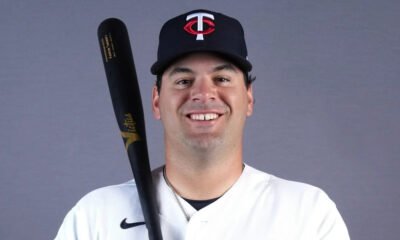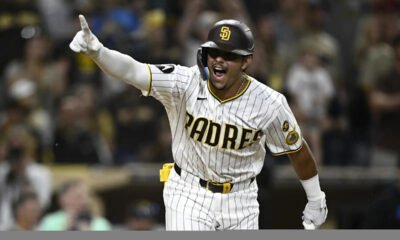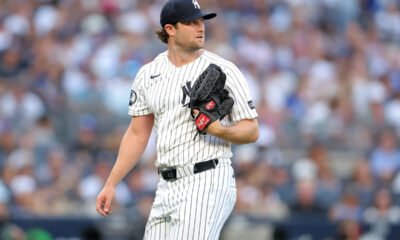
Jacob Misiorowski‘s fastball. Kyle Schwarber‘s power. Shohei Ohtani‘s … well, everything.
As baseball’s best players gather in Philadelphia for the 2026 MLB All-Star Game, we are reminded of the too-many-to-count reasons we love to watch each of them play the sport.Because of injuries and pitching schedules, not all of them will be on display Tuesday night. But they have represented the best of baseball all season long.
Ahead of this year’s Midsummer Classic, we asked ESPN MLB experts Bradford Doolittle, Buster Olney, Jeff Passan and David Schoenfield to choose a few of the players whose singular skills make them must-sees whenever they take the field. We then asked their fellow All-Stars to weigh in on what makes each of them impressive — even to their peers.
Corbin Carroll when he gets greedy for a triple
Triples are kind of a fluke event in today’s game, a hard-to-replicate combination of speed and ballpark. Nevertheless, Carroll has become an elite triples hitter, leading the National League season after season, making him the master of baseball’s most exhilarating play.
The Arizona Diamondbacks right fielder seems almost greedy about triples — in the best possible way. He flies around first base, and by then he knows, accelerating and making the turn at second with an almost maniacal look on his determined face. As soon as Carroll plugs a gap in the outfield, you have to sit up straight and watch him fly. And as for that greed? He is up to 53 career triples and has never been thrown out trying to stretch what otherwise might be a ho-hum double. — Doolittle
A fellow All-Star’s take:
He’s just a freak. Just a quick, twitchy guy. He’s not the biggest guy, but pound for pound, he has some of the most juice in the big leagues. He just does everything so well. — Pete Crow-Armstrong
There is an everyman within theToronto Blue Jays‘ second baseman that shined through during last year’s playoffs and World Series. During the epic seven-game Series against the Los Angeles Dodgers, Clement once chatted during batting practice about how much fun he was having, how cool it was to be in that time and place.
The Aaron Boone lookalike has reached this place through a path of twists and turns:
After he was drafted in the fourth round by the Cleveland Guardians in 2017, he was claimed off waivers by the Athletics in 2022, released in spring training the following year and picked up by the Jays. And this year, while batting .296 with a league-leading 23 doubles, he received more All-Star votes than any other American League player. His happy grin might be indelible. — Olney
A fellow All-Star’s take:
We all believed he could become an All-Star, but it just goes to show that you never give up. Anything is possible. His joy is contagious. Absolutely. Ernie’s the guy for that. He always has a smile on his face, the best attitude in the clubhouse, and it shows. — Louis Varland
A great defensive center fielder needs raw speed, and Crow-Armstrong has plenty of that, ranking in the 95th percentile in his top speed score. A great center fielder needs the instincts to give him a quick first step upon contact, and Crow-Armstrong has that, which is why he ranks first among all fielders in Statcast’s fielding run value, at plus-17 runs.
A great center fielder needs a strong throwing arm, and Crow-Armstrong has that, ranking in the 91st percentile in arm strength. A great center fielder must also be fearless, and that also describes Crow-Armstrong’s willingness to make the spectacular diving catch.
Is the Chicago Cubs All-Star the best center fielder in baseball in 2026? It’s hard to argue against that. But there’s also this argument: Are we watching the best defensive center fielder of all time? — Schoenfield
A fellow All-Star’s take:
If you hit out there, it’s usually caught. So, you know, hit it over the fence or just don’t hit to PCA. — CJ Abrams
Freddie Freeman stacking line drives in batting practice
Freeman is on his way to a 16th straight season of posting an OPS+ of 110 or better. It will be his 14th straight at 130 or better, making him one of 23 players to record that many seasons at that level. If there is one on-field trait undergirding Freeman’s Hall of Fame trajectory, it’s the consistency required to post those numbers.
Nothing demonstrates how the Dodgers first baseman has achieved this kind of sustained excellence more than simply watching one of his metronomic batting practice sessions. The goal of each and every swing is to hit a line drive at the shortstop position. And so Freeman slaps one drive after another that typically flies over the shortstop and plugs the left-center-field gap. Again and again and again. You want to see how routine leads to consistency that leads to greatness? Just watch Freeman in the cage. — Doolittle
A fellow All-Star’s take:
He covers such a wide range in the strike zone. He knows how to fight off pitches and take a single and absolutely capitalizes on mistakes pitchers make. He can adjust mid-at-bat — make that mid-pitch! — Nick Martinez
There are two players in MLB this season with walk and strikeout percentiles above 88%: Juan Soto and Kevin McGonigle. One is a 27-year-old in his ninth season on a Hall of Fame track. And the other is a rookie. And if that doesn’t begin to explain just how special McGonigle is, consider that he’s already among baseball’s best baserunners. And that he has played capably at both positions on the left side of the infield for the Detroit Tigers.
And on we could go, but this is about his approach. The one where he has the third-lowest chase rate in MLB. The ability to differentiate between ball and strike is baseball’s greatest gift, because it allows a hitter to shrink his zone and hunt good pitches to hit. That McGonigle is doing it at 21, less than three years removed from high school in suburban Philadelphia, is even more remarkable. When he gets his All-Star at-bat, the cheers will be louder than most for AL hitters, and he’ll do what he always does: work a plate appearance to the fullest extent possible. — Passan
A fellow All-Star’s take:
Kevin’s been awesome. He’s fit right in with the team. He’s not even what a lot of people expect him to be, like a rookie, a little brother. He’s not even a little brother. He’s just one of us. He’s a great kid, great player. You wouldn’t be able to tell he’s a rookie, right?– Dillon Dingler
Mason Miller blowing hitters away in the ninth
Miller’s choice of Korn’s “Blind” as his entrance music immediately leapt into the pantheon of closer unveilings, an inspired bit of auditory synchronicity every bit on the level of the trumpets sounding Edwin Díaz’s arrival or Mariano Rivera putting hitters to sleep. “Are you ready?” screams Jonathan Davis in the song’s first words.
No, actually. They’re not ready. Because the San Diego Padres closer throws harder on average than anyone — at 101.2 mph, he even has Jacob Misiorowski beat — and he also leads MLB in so many categories his Baseball Savant page looks like someone stamped it with the 100 emoji. And all of this undersells his slider, which by pitch-type value is actually even better than his fastball. Nothing is certain in baseball. Ever. But the closest thing to it might be when the door swings open, the A chord makes it sound like doom is nigh and Mason Miller takes the mound. — Passan
A fellow All-Star’s take:
I faced him last year and, yeah, it’s electric. It’s hard to hit. There’s only a few guys like him in the game of baseball. — Corbin Carroll
Baseball at its best makes the unthinkable reality, and that feeling suffuses every Jacob Misiorowski start. It’s the fastball. It’s lots of other stuff, of course — the cutter at 96 mph and the slider and the curveball and even a rarely used but still quite nice changeup — but, yeah, we all come to the party to see the heater. And what a pitch it is. Averaging 100.5 mph, the hardest ever for a starter by 1.6 mph. Ten fastballs at 104 mph. And one at 105.5.
We’ve never seen anything like the Milwaukee Brewers ace. Nothing close. It’s like if you took every elite reliever’s best pitch and Voltron’d them into a 6-foot-7, 190-pound human. Misiorowski’s first half, in many ways, resembled that of Pedro Martinez’s legendary 2000 season. Pedro 106 innings, Misiorowski 111. Pedro a 1.44 ERA, Misiorowski 1.62. Both allowed nine home runs. Pedro struck out 140 and walked 20, Misiorowski 167 and 27. And Misiorowski can keep such righteous company because of the heater he throws 63.1% of the time — and it seems like it works every time. — Passan
A fellow All-Star’s take:
It’s better to have him on my team than as an opponent. He’s a tremendous pitcher, a tremendous horse. He deserves it. There isn’t anyone else who can throw more than 60 pitches in a game 102-plus. So he’s a guy who deserves everything he’s gotten. His mentality has changed this year. Last year, his mentality was to throw hard, and this year he’s pitching more. He works at it, and he’s improved.– William Contreras
There are some things that anyone who has been following the game since childhood could have reasonably assumed we’d never see. One of those things is a player who not only replicated the two-way greatness of Babe Ruth but went beyond it.
I’ve seen Ohtani pitch in person, including twice in last year’s World Series. I’ve seen him hit home runs in person quite a few times, including once in Chicago when he was with the Los Angeles Angels, mashing one to center at the very moment I was explaining to my father-in-law why he was being referred to as the Japanese Babe Ruth. I’ve seen him on TV, walking off the mound and getting ready to lead off the next inning as a hitter.
And yet I want to get a pass sometime that allows me to shadow the Dodgers All-Star every second of a day in which he starts on the mound and hits. Because after all these years, I still have a little voice in my head telling me it can’t be the same person. — Doolittle
A fellow All-Star’s take:
Everyone is in awe of what he does. Us players, too. I did a little bit of two-way in college, but not even close to what he’s doing. He’s the best. On the mound, he spins it so well. He’s coming at you with everything, pounding the zone. — Max Meyer
Nobody throws a changeup as much as Sánchez, and considering he went 50 innings at one point without giving up a run, maybe someone else should give it a whirl. Sánchez’s 702 changeups this season are 230 more than the next such artist, Michael King, and their excellence is a reflection not just of the pitch’s gnarly movement but how perfectly it complements his sinker. Sánchez’s release points on his 87 mph changeup and 95 mph sinker are almost identical, which means hitters have 53 feet — he gets almost 7 feet of extension — to figure out that 8 mph difference.
It’s no wonder the Philadelphia Phillies lefty succeeds like he does. Velocity plus deception plus movement is a recipe for success. The most dastardly pitch in baseball is a good changeup, and Sánchez’s is the best. — Passan
A fellow All-Star’s take:
I think he just gets better and better every time out. I think it’s no surprise, if you watch him work and the way he goes about his business and his work ethic. He’s just an example to follow. He’s a great teammate on and off the field. — Jesus Luzardo
Cam Schlittler‘s meteoric rise to an ice-in-his veins ace
The New York Yankees drafted Schlittler in the seventh round out of Northeastern in 2022. His fastball averaged 90 to 93 mph, pedestrian by today’s standards. Then he started throwing harder. And harder.
When he burst onto the scene with the Yankees in the second half of last season, he was throwing 98. He made headlines with a dominant 12-strikeout, no-run performance in the postseason and then posted a 1.50 ERA through his first 12 starts this season. The remarkable thing about Schlittler: He throws his four-seamer 45% of the time, his cutter 27% and his sinker 20% — that’s variations on his fastball 92% of the time. It obviously works: He leads the AL in ERA (2.05), WAR (4.1) and lowest OBP allowed (.247).
His dad is a police chief in Massachusetts, and Schlittler credits him for his stoic presence on the mound and ability to pitch through pressure situations. — Schoenfield
A fellow All-Star’s take:
Just having those three electric fastballs. They’re all hard and he’s coming at you with high velocity. He’s got that little, I think, attitude to him, just how he pitches. It’s one of those at-bats you’ve got to gear up and get locked in. He’s got the stuff and backs it up. —Bobby Witt Jr.
Schwarber was built to hit home runs. He was not built to run the bases with speed and fluidity. He was not built to patrol the outfield with the graceful strides of a lithe center fielder. He was not built to flip little soft singles to the opposite field. No, he was built to swing a baseball bat to produce long, towering home runs that soar into upper decks.
I picture the Phillies DH in a former life as one of those lumberjacks in an old black-and-white photo, standing next to a giant redwood. He has just exchanged his weapon of destruction. Fifty-six home runs in 2025, looking on his way to that many again in 2026, two other seasons of 46 and 47, and perhaps now on his way to 500 in his career. Artistic? Maybe not. Impressive? When the ball flies 450 feet, absolutely. — Schoenfield
A fellow All-Star’s take:
I think you have to start putting him up there with a lot of the great sluggers. Not a lot of guys are like him, in just the amount of home runs he hits and the frequency with which he hits them, right? He is kind of the three-true-outcome guy, but what I’ve found out, he can hit a little bit. He’s a tough out. If you don’t get the ball to the right spots on him, watch out. — Don Mattingly
Mike Trout‘s response to the All-Star stage
Citizens Bank Park is 38 miles from Trout National, the golf course Mike Trout constructed near his hometown of Millville, New Jersey, and so he’ll feel right at home in the All-Star Game. But he has always felt comfortable on the big stage, as he has demonstrated in past Midsummer Classics. He has been part of 12 All-Star teams in his career, and in past games, he’s 7-for-17, with a homer, two doubles and four runs scored.
He is 34 years old now, and as his former Angels teammate Albert Pujols said recently on the “Baseball Tonight” podcast, it’s possible that any All-Star invite might be the last of your career — and, in a season in which Trout has been relatively healthy, he’s going to enjoy this moment on the major league field closest to his home. — Olney
A fellow All-Star’s take:
I’ve got to play against him a couple times now, and it’s still really cool every time he steps up to the plate and I get to say hello to him. He’s a very special player, and getting to see what kind of career that he’s had and still retaining his ability after the injuries is impressive. The players definitely have a lot of respect for him. — Dillon Dingler
Bobby Witt Jr. running down a blooper in shallow left field
Back when I covered the NBA, I sat in the media section underneath the basket at the United Center many times during Derrick Rose’s MVP season. That vantage point puts the surreal athleticism of NBA players on full display, and I am part of the chorus that touts those athletes as the best in the world. At that point, Rose’s surreal quickness and explosiveness made other NBA players look like they were wearing concrete sneakers. To me, Witt is the baseball equivalent of that, with traits that leap out even when held against the other best ballplayers in the world.
The Kansas City Royals shortstopdemonstrates this in so many ways, but my favorite is when he bolts after a foul pop that looks like it’s headed for no-man’s-land, that spot where none of the third basemen, left fielders or shortstops can quite reach. Witt gets there, skirting across the field like a water bug, sliding under the blooper and turning a non-event into an embedded memory. — Doolittle
A fellow All-Star’s take:
As a pitcher, we’re always talking about defense. Whenever you look at a team with great defense, they’re solid up the middle and saving runs. That’s what Bobby does for his team. He’s impacting the game on both sides of the ball and making the type of [play] that fuels teams to win ballgames. The high energy gets the morale high and motivates everyone to want to play at that level. — Nick Martinez
— with ESPN’s Jorge Castillo and Jesse Rogers
Copyright © 2026 ESPN Internet Ventures. All rights reserved.

Source link