Back home, nobody seemed ready to go to bed.
At 2 a.m. Sunday, thousands of fans dressed in red, white and blue streamed through Oslo toward the Royal Palace. Flares burned above the crowd. Fireworks cracked over Karl Johans gate. People sang the national anthem and passed around slices of brown cheese.
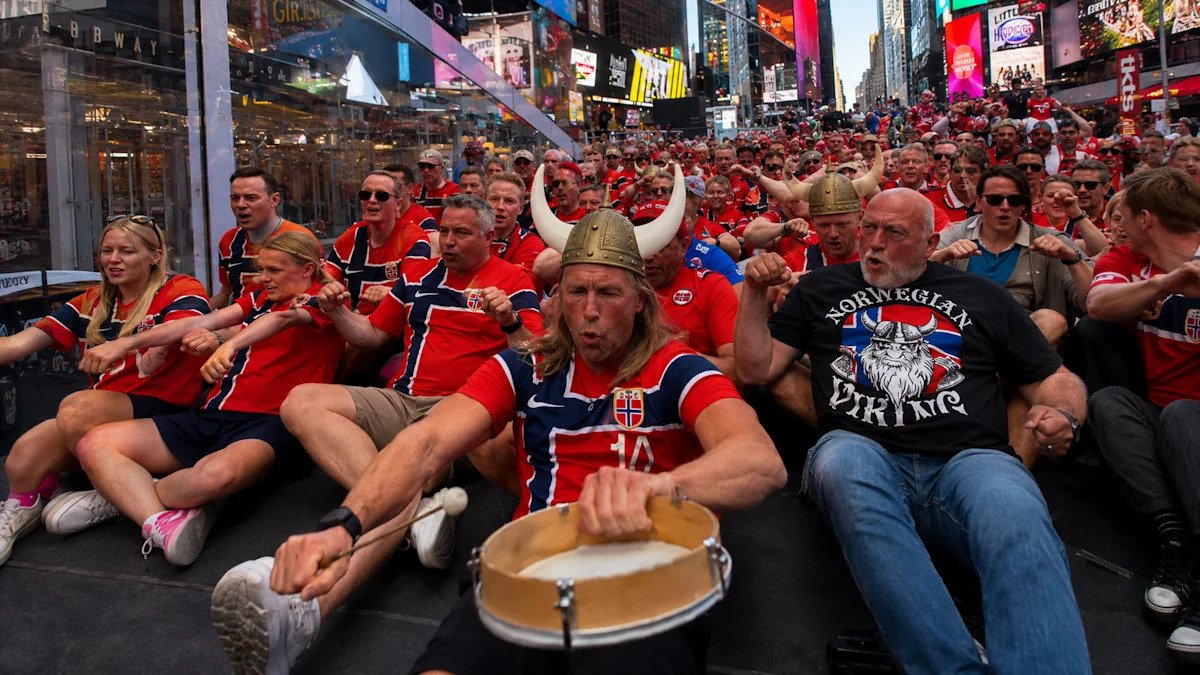
Then, for what looked like one final time, they sat down and began to row.
The videos are among the most moving I have seen at this World Cup. Norway had just been eliminated, but the crowd did not look defeated. The fans pulled their imaginary oars together and shouted “Ro!” into the night, closing a tournament that turned a nation of 5.6 million people into its most heartwarming supporting cast.
Norway did not win the World Cup. It did not even reach the semifinals. But it gave the tournament something that will be much harder to reproduce: a fan celebration that was instantly recognizable, completely participatory and just ridiculous enough to work.
The Viking Row went from Norwegian stadiums to Times Square, subway cars, beaches, airports, golf tournaments, fighter jets and the floor of the Norwegian parliament. I kept thinking it had reached its natural conclusion, only for another video to appear on my feed from somewhere even less predictable.
By the time Norway’s players left the field in Miami, the row no longer belonged only to them. The clearest proof came after the World Cup final, when Spain’s celebrating fans performed it in Madrid.
Norway’s final Viking Row felt more like a celebration than a goodbye
Norway had plenty of reasons to be disappointed.
The country had reached its first World Cup in 28 years, then made its deepest run ever. After advancing from the group stage, Norway beat Côte d’Ivoire in the round of 32 and stunned Brazil 2-1 in the round of 16. England finally ended the run in the quarterfinals, scoring the winner during extra time.
Four years earlier, the idea of Norway reaching this point would have sounded wildly optimistic. Before this tournament, the country had never won a World Cup knockout match. So the end finally came, the internet was not ready to say goodbye.
Another video described the gathering as Norway fans bidding an emotional farewell with one final Viking Row. In the comments, people from outside Norway thanked the supporters for what they brought to the tournament.
There were chants about winning the European Championship in two years. Fans sang, waved flags and filled the avenue leading to the Royal Palace.
A chant designed for a stadium took over almost everything else
The Viking Row looks as though it has been passed down through generations of Norwegian football supporters. In reality, it was created for this World Cup.
Ole Frøystad, a Norwegian primary school teacher, developed the idea after thinking about the rhythmic chant used by supporters of Rosenborg BK. The Norwegian word “ro,” meaning “row,” gave him the visual: fans sitting together, pulling imaginary oars as though landing a Viking ship before battle.
Frøystad worked with members of the Norwegian supporters’ group Oljeberget to refine it. They tested the chant in March, made instructional videos before Norway’s final pre-World Cup friendly and shared it heavily on social media. One early video posted by Frøystad eventually drew tens of millions of views.
Soon, entire sections of stadiums were rowing. Norway’s players joined after matches, with captain Martin Ødegaard sometimes leading the motion from the field. Erling Haaland shared one video with the message, “This is bigger than football,” and described the sight of thousands rowing with the team as something that gave him goosebumps.
Then the row escaped the stadium.
The internet kept finding new places for Norway to row
More than 500 Norwegian supporters gathered in Times Square early in the tournament, turning one of New York City’s busiest intersections into a temporary Viking ship. Americans with Norwegian roots showed up to watch, and some joined in.
Videos followed from subway escalators, airport terminals and Miami Beach. Prince Sverre Magnus, third in line to the Norwegian throne, rowed inside an Oslo subway car. Residents of a rural care home joined from their chairs. Norwegian Royal Air Force pilots performed their version inside F-35 fighter jets.
The Norwegian parliament may have produced the strangest example. Lawmakers in suits sat at their desks and pulled invisible oars in unison inside the ornate chamber. The scene looks like the beginning of a comedy sketch, except nearly everyone commits to it.
You did not need to know Norway’s lineup or understand what had happened in its group. Watching a row of adults suddenly behave like the crew of a longship provided all the necessary context.
The row also became part of the larger online world that formed around Norway. Airlines started teasing each other. American Airlines jumped into the comments. SAS promoted a plane named after a Norse figure. Before the quarterfinal, Norwegian Air challenged British Airways to a bet requiring the losing airline to temporarily use the winner’s logo on Instagram.
After England won, Norwegian followed through, swapped its profile picture and congratulated British Airways. It was a fitting final act for a team whose tournament had inspired almost as much entertaining material away from the field as it had on it.
Other fans began rowing with Norway
The clearest sign that the Viking Row had become bigger than a national-team chant came when everyone else started doing it.
Supporters from other countries copied it. Visitors encountered Norwegian fans in American cities and sat down beside them. Mexico fans practiced their own version. Stadium crowds, including plenty of people wearing other teams’ colors, joined the motion.
Even after Norway was eliminated, the rowing continued.
When Spain beat Argentina in the World Cup final, fans celebrating in Madrid broke into the Viking Row. FOX Sports shared the video with the caption, “The Norwegian Row lives on in Madrid after Spain won the FIFA World Cup.”
Norway was no longer in the tournament. The celebration it created had made it all the way to the champion’s victory party.
Norway left the tournament with something worth keeping
There will be more matches, louder celebrations and another country lifting the World Cup trophy.
But I am not sure any remaining team can create what Norway did over the past month. The Viking Row arrived with a clear visual identity and spread fast enough to become part of the tournament while Norway was still playing. By the quarterfinals, it no longer looked like a novelty. It looked like a World Cup tradition.
The final row outside the Royal Palace gave it an ending that could not have been planned better.
Thousands of people stayed out until the early hours after a painful loss, sat down together in the street and performed the same motion that had carried them from the group stage to the quarterfinals.
The team was out. The oars kept moving.

Source link